
I didn’t plan this trip. I didn’t even pick the destination. One quiet afternoon, with too much on my mind and no real agenda, I spun a globe. Closed my eyes. Let my finger fall. It landed on Marrakesh.
At first, it felt like a joke. Then, oddly, like a sign.
Within days, I was on a flight to Morocco with a backpack, a camera, and a vague sense that I needed to be somewhere unfamiliar. What I found was a city that didn’t ease me in—it pulled me in. The kind of place that demands your attention and offers something real in return.
I arrived with no itinerary, just the name of a riad scribbled in a notebook and the usual mix of jet-lagged curiosity and doubt. The airport was a blur. The air was warmer than expected. Somewhere between the taxi ride and the first glimpse of the medina walls, it hit me—I was really here.
The city greeted me with sound. Horns, calls to prayer, shouting vendors, clattering carts. I wandered through the chaos, trying to look like I knew where I was going. I didn’t. But I wasn’t after control. I was looking for something to shake me out of my sleep.
On my second day, still disoriented but eager, I joined one of the private tours in Marrakech. It felt like the right way to follow the rhythm of the city without being flattened by it. The guide didn’t recite facts—he told stories. We slipped through spice stalls and alleyways at the easy pace of someone who belonged there.
By the end of the day, I wasn’t just oriented—I was tuned in.
Marrakesh speaks in saturation. Red earth. Glazed tile. The scent of citrus, cumin, and diesel. It’s a place where everything feels amplified—like the volume’s been turned up on life itself.
In the medina, time warps. I wandered through narrow alleys where rust-colored walls opened without warning into bright courtyards. A man grilled sardines on a tin stove. A boy biked past with bread under one arm. I stepped aside and was invited into a stall by a vendor offering tea and a lesson in rug weaving.
Every turn offered something different: a burst of oud from a perfume shop, the glint of hand-hammered brass, voices layered in Arabic, French, and laughter. It was intense. Unpredictable. But deeply energizing.
You can’t drift through Marrakesh. The city expects you to arrive fully prepared. And when you do, it responds.
After hours in the medina, I started to crave stillness. The kind of quiet you forget exists until you’re in it again. In Marrakesh, that kind of calm lives behind doors.
My riad was unmarked—just a carved knocker and a sliver of tile at the entrance. But stepping inside felt like crossing into another reality. The noise vanished. A courtyard opened around me: mosaic floors, citrus trees, and the soft sound of water trickling from a fountain.
These sanctuaries are scattered all across the city. I spent slow mornings with coffee on the rooftop and quiet evenings reading beneath jasmine vines. No notifications. No rush. Just time stretching out, soft and uninterrupted.
There’s something about being alone in a foreign place that sharpens your senses. You begin to notice what you’ve been avoiding—and what you’ve been carrying that no longer belongs.
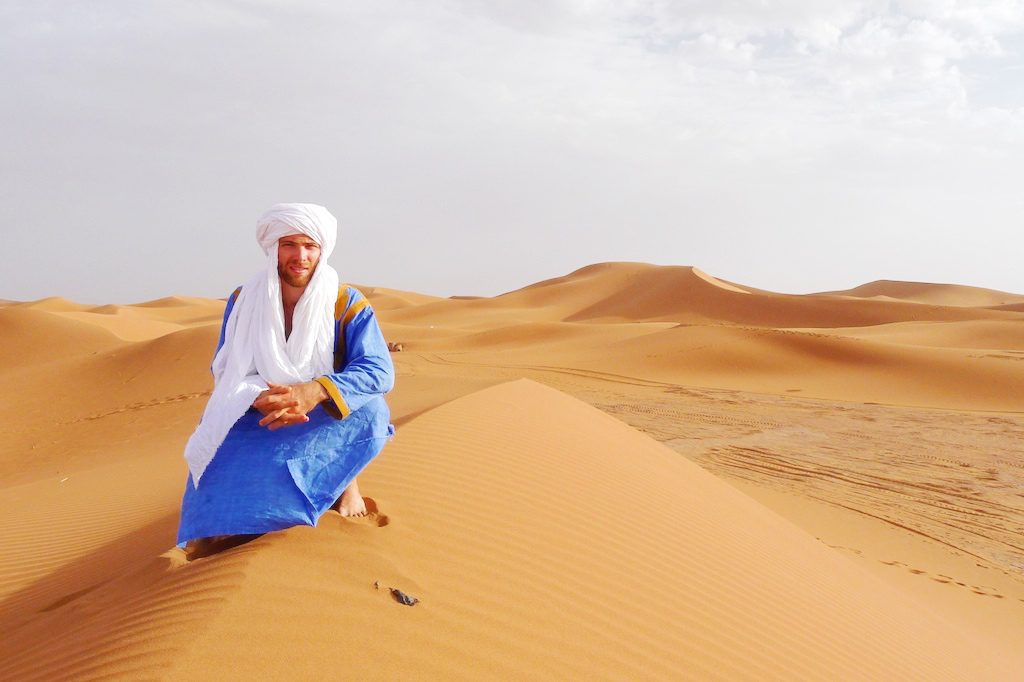
I hadn’t planned on leaving the city. But someone at the riad mentioned a desert camp outside Marrakesh—nothing fancy, just canvas tents, camels, and stars. It sounded like exactly the kind of detour this trip was meant for.
We drove past low-slung villages and scrubby plains until the city disappeared. The landscape flattened. The desert wasn’t cinematic—it was dusty, wide, and slow. But that’s what made it feel real.
The camels moved like they’d done this a thousand times. I focused on not falling off, on the sway, on the silence. Then I stopped thinking at all. The horizon stretched out endlessly, and so did my mind.
At camp, dinner simmered under the open sky. The sun dropped behind the dunes. The conversation faded. The stillness that followed wasn’t empty—it was expansive. A guide pointed out constellations I’d never seen so clearly. Someone played a hand drum. We sat quietly by the fire, and somehow that felt like enough.
Even here, culture flowed beneath the quiet. Morocco’s blend of Berber, Arab, and Saharan heritage shapes everything—from food to rhythm. Lonely Planet calls Marrakesh one of the world’s most sensory destinations. That doesn’t stop at the city limits. It just changes texture.
I came to Marrakesh on instinct. No checklist, no route. Just a sense that I needed to be somewhere that challenged my sense of direction—and maybe rebuilt it.
Traveling like this changes you. It loosens your grip on certainty. You begin to say yes more. You stop trying to orchestrate moments, and you start being in them. Mint tea with strangers. Sunlight on tiled floors. A rooftop at dusk with nowhere to be.
Before I left, I walked the medina again—just to walk. I passed two travelers glued to their phones, looking frustrated. I wanted to tell them to pause, to look up. But maybe the city would catch them, too, like it did me.
If you ever spin the globe and land somewhere unexpected, let Marrakesh be one of the places you don’t overthink. It has a way of pulling you in when you’re ready.
And if you want to see more of what this country can offer, here are some of the best places to visit in Morocco. You might find exactly what you didn’t know you were looking for.
Counter
101 Countries • 1432 Cities