
Nobody told me that college campuses could feel sacred. I don’t mean that in a religious sense. I mean the way certain places carry weight. A quietness that isn’t really quiet. The feeling that something important happened here, or is about to.
I drove across six states one summer with a loose itinerary and a car that needed an oil change I kept postponing. The plan was national parks. What actually happened was that I kept stopping at college campuses. They weren’t on any list I’d made. I’d pull off for gas, see a gate or a bell tower in the distance, and end up walking around for an hour.
That’s how I learned something: American university campuses are among the most architecturally and geographically ambitious spaces in the country, and most travelers completely ignore them. That seems wrong to me.
There’s a practical case and an aesthetic one. Practically speaking, most campuses are free to enter, well-maintained, and situated near good food and public transit. They have maps, bathrooms, and benches. They’re built for wandering. The aesthetic case is harder to summarize but more important: these are places where decades of institutional investment in beauty collide with the particular energy of people figuring out who they are. That combination creates something you can’t quite replicate elsewhere.
The American Institute of Architects has repeatedly cited university architecture as one of the most significant categories of American building. And a 2019 report from the National Trust for Historic Preservation noted that over 40% of historically designated campus structures predate the Civil War. That’s not trivia. That’s context for why walking through certain quads feels like something.
Here are the campuses I’d recommend without hesitation. Not for their rankings or reputations. Just for what they actually feel like when you’re standing in the middle of them.
University of Virginia, Charlottesville Thomas Jefferson designed the original Academical Village himself, and it shows – not in an ostentatious way, but in the sense that every proportion feels considered. The Rotunda anchors the Lawn, and the colonnaded pavilions stretch out from it with a confidence that doesn’t need to announce itself. I went in October when the trees were turning and students were reading on the steps and I stood there for longer than I should have. It’s one of the few campuses that functions as a UNESCO World Heritage Site. That designation feels right.
Duke University, Durham, North Carolina Duke’s West Campus was built in the 1930s in Collegiate Gothic style, and the effect is borderline theatrical. Duke Chapel sits at the center and its 210-foot tower is visible from across the grounds. The stone is real – limestone and granite – and the interior of the chapel has this layered silence that I didn’t expect from a weekday afternoon visit. The Sarah P. Duke Gardens, 55 acres attached to campus, are worth an hour on their own.
University of Washington, Seattle The quad in spring. That’s the whole reason. Cherry trees planted in the 1930s bloom in late March and early April and the photographs don’t do justice to being under them. Rainier Hall, the Red Square, the Suzzallo Library with its Gothic reading room – UW is architecturally rich in a way that surprises people who expect the Pacific Northwest to be all glass and cedar.
Sewanee: The University of the South, Tennessee This one doesn’t get mentioned enough. Sewanee sits on a 13,000-acre domain on the Cumberland Plateau, and the campus feels removed from time in a way that’s hard to describe without sounding dramatic. All Souls’ Chapel is genuinely stunning. The whole place has an atmosphere that rewards slow walking. It’s the kind of campus that makes you understand why someone would choose a place over a name.
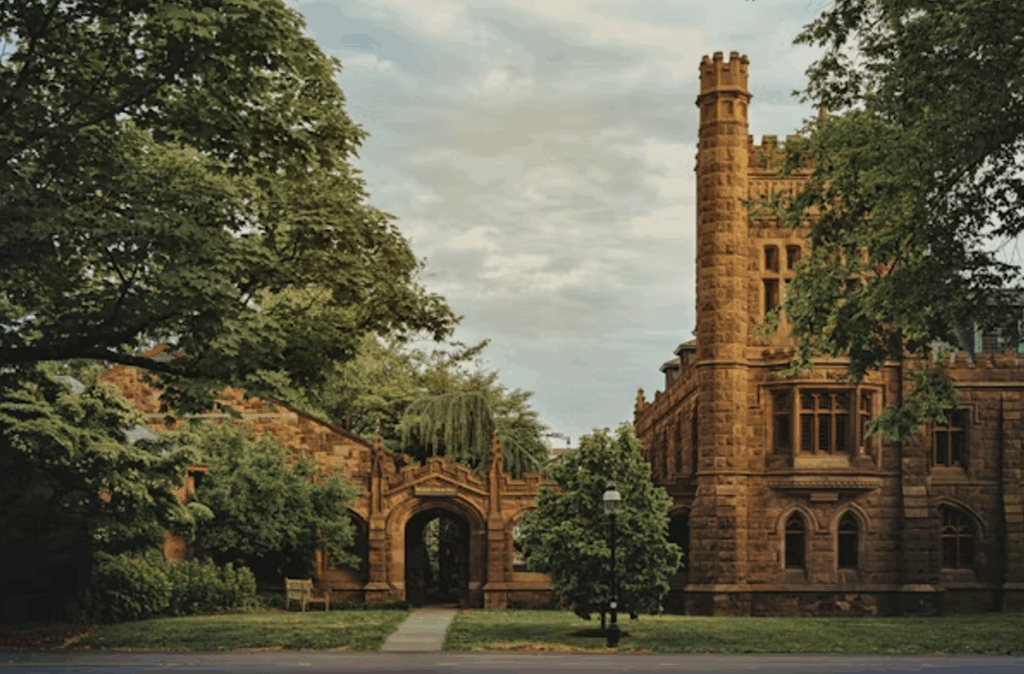
Princeton University, New Jersey Nassau Hall has been standing since 1756. The whole campus is an argument for architectural continuity – different eras of building that somehow cohere, connected by paths and lawns that feel intentional rather than merely accumulated. Blair Arch, the Chapel, Firestone Library. What distinguishes Princeton isn’t any single building but the cumulative effect of them, the way the campus insists on being taken seriously.
Stanford University, California The sandstone and red tile roofs set against the Santa Cruz Mountains in the background – it’s immediately striking in a way that feels almost unfair to other campuses. Memorial Church anchors the Main Quad. The Rodin Sculpture Garden sits near the art museum. Stanford’s visual identity is so specific that it has influenced the design of dozens of other institutions. Frank Lloyd Wright’s Hanna House is also on campus and worth seeing if you can arrange it.
College of William & Mary, Williamsburg, Virginia The Wren Building, completed around 1700, is the oldest academic building still in use in the United States. That alone warrants a detour. The campus sits adjacent to Colonial Williamsburg, which gives the whole visit a layered historical texture. It’s small enough to walk entirely and dense enough to reward that walk.
| Campus | Location | Signature Feature | Best Season to Visit |
| University of Virginia | Charlottesville, VA | Jefferson’s Lawn & Rotunda | Fall |
| Duke University | Durham, NC | Duke Chapel & Gothic architecture | Spring or Fall |
| University of Washington | Seattle, WA | Cherry Blossom Quad | Late March–April |
| Sewanee: The University of the South | Sewanee, TN | Cumberland Plateau setting | Fall |
| Princeton University | Princeton, NJ | Nassau Hall & Blair Arch | Spring or Fall |
| Stanford University | Palo Alto, CA | Main Quad & Memorial Church | Year-round |
| College of William & Mary | Williamsburg, VA | Wren Building (est. ~1700) | Spring |
Tour groups move too fast. The official admissions tour is optimized for families deciding whether to apply. That’s not a useful frame for a traveler. What I’d recommend instead: download a campus map, identify two or three anchoring buildings, and give yourself ninety minutes with no agenda. Sit somewhere. Read a plaque. Go inside a library if they’ll let you – most will during business hours.
At Duke, I wandered into a building I thought was open to visitors and ended up in a hallway full of student artwork before a very polite administrator redirected me. At UVA, I found a corner of the Lawn behind one of the pavilions where students had left chairs out and somebody had forgotten a coffee cup. It felt genuinely lived-in, which the grander spaces sometimes don’t.
The difference between a campus that photographs well and one that feels right in person is harder to quantify. UVA photographs beautifully and feels just as good when you’re there. Some campuses that rank highly in architectural surveys feel oddly sterile in person – too curated, not enough life at the edges.
Campus visits during a road trip have a particular kind of mental utility. You’re moving constantly, absorbing landscapes and highways, and then you stop somewhere with deep historical roots and you feel the contrast. It recalibrates something.
I was thinking about this on the drive to Sewanee, actually. I’d been listening to a podcast discussing how students increasingly outsource academic tasks – whether that’s using tutoring services, software tools, or even paying someone to write a research paper. The conversation was more nuanced than the usual moral panic framing. But what struck me was the counterpoint buried inside it: that the physical experience of being in a place of learning still means something that can’t be outsourced or replicated. Campuses hold that meaning in their architecture, in their scale, in the way they insist you walk slowly and look up.
There’s also a simpler version of this. Students under serious academic pressure sometimes look for shortcuts – someone might pay for homework during a brutal stretch of finals, or use a writing service to buy time. That’s a real and complicated thing. But visiting a campus as a traveler, with no deadlines and no institutional obligation, gives you access to the learning environment in its purest form. Just the space itself, stripped of anxiety.
That’s an underrated kind of visit.
I don’t think beautiful campuses are important because they’re prestigious or because they signal something about academic quality. Some of the most beautiful campuses in America belong to schools most people couldn’t rank. Sewanee. The University of the South. Reed College in Portland. Rhodes College in Memphis.
What these places share is a conviction – sometimes explicit in their founding documents, sometimes just embedded in the stone – that the environment of learning matters. That where you think is part of how you think.
Travelers who skip campuses are skipping one of the more honest expressions of what American institutions believed they were building. Whether or not those beliefs held, the buildings remain. They’re worth seeing before the light changes.
Counter
101 Countries • 1432 Cities