
There is a specific kind of magic that happens the moment you order food in the local language and the person behind the counter breaks into a genuine smile. It is small, it barely takes ten seconds, but it changes the entire texture of the interaction. You are no longer just another tourist pointing at a menu. You are someone who made an effort, and that effort gets noticed.
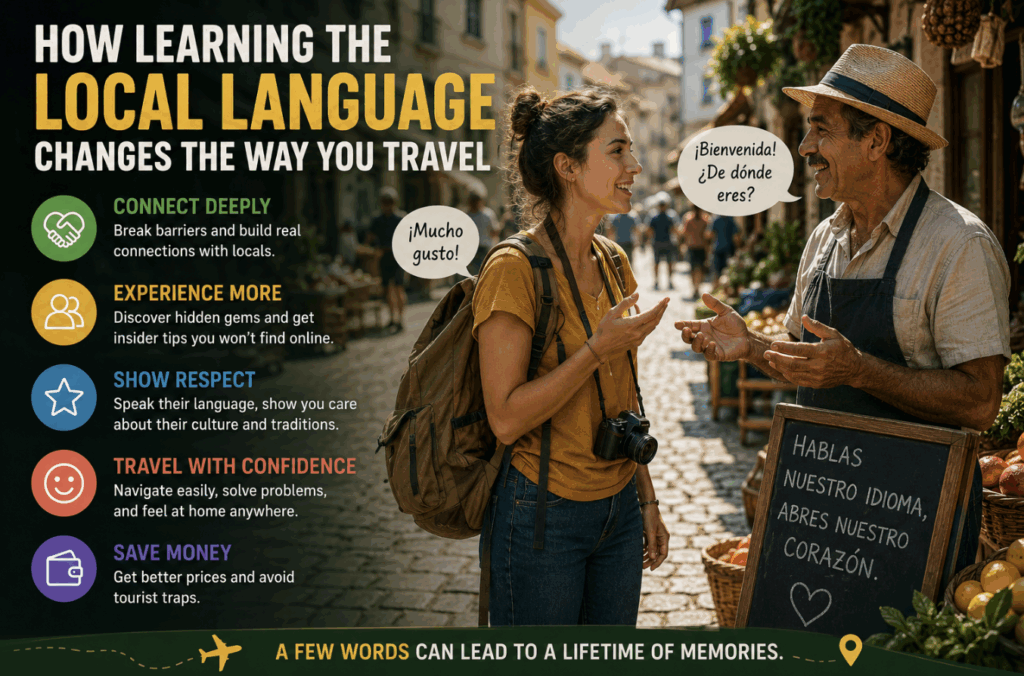
I have watched this play out in markets, train stations, and family-run trattorias on nearly every continent. The travelers who pick up even a handful of local words tend to have richer, warmer trips than the ones who stick entirely to English. It is not about fluency. It is about showing up with a little effort and letting that effort open doors.
If you have a trip coming up and you are wondering whether it is worth the time to learn some of the language beforehand, here is what actually changes once you do, and how to make the process painless enough to fit into a busy pre-trip schedule.
I get why it feels intimidating. Most of us associate language learning with school, with verb conjugation tables and quizzes that never quite stuck. Trip prep is a different kind of learning entirely. You are not trying to pass an exam. You are trying to get comfortable enough to order a meal, haggle a little at a market, or laugh along with a joke you actually understood. That is a much lower bar, and it is one almost anyone can clear with a few weeks of casual effort.
Most travelers experience a destination through a kind of glass wall. You see the market, you smell the food, you watch locals talk and laugh, but you are not quite inside any of it. Learning even basic phrases breaks that wall down. Suddenly you can ask the fruit vendor which mango is ripe, or understand the joke the waiter just made at your table.
A recent survey found that 97 percent of travelers who prepared even a little local language saw real benefits from doing so, yet only a little more than half actually bothered to learn any phrases before their trip, even though most people agree it matters. That gap is exactly where the opportunity sits. The people willing to close it end up with noticeably better stories to bring home.
This is a big part of why a destination like Italy feels completely different depending on whether you show up with a few Italian phrases in your pocket or none at all. The history and the food are there either way, but the connection with the people is what actually stays with you.
Promova is a language learning app for people who want to speak, not just memorize vocabulary lists. It pairs structured self-study with AI-powered conversation practice, so instead of drilling flashcards for weeks, you actually rehearse the kind of exchanges you will have in real life: ordering a coffee, checking into a hotel, asking someone for directions.
If Italy or another Italian-speaking region is on your itinerary, this is the best app to start speaking Italian without signing up for a semester-long course you will never finish. You can run through a conversation on your lunch break or during a layover, and the AI tutor adjusts to whatever level you are actually at instead of assuming you already know the basics.
There is also a benefit that has nothing to do with the trip itself. Researchers studying bilingual brains have found that people who regularly switch between languages tend to have sharper attention and better task-switching ability than people who only speak one. You are not going to become bilingual from a two-week trip, but every bit of practice nudges your brain in that direction, and that effect sticks around long after you unpack your suitcase.
It also changes how you move through a destination physically, not just conversationally. Once you can read signs, menus, and basic instructions, you naturally wander further from the main tourist strip. That is usually where the best food is anyway, and it lines up with something I have said for years: the same instincts that help you eat like a local instead of a tourist are the same instincts that push you to try a few words of the local language instead of defaulting to English every time.
You do not need three months of lessons. You need a few weeks of short, consistent practice, ideally tied to situations you already know are coming up on the trip. If you are flying into Rome, practice the conversation you will have with a taxi driver. If you are staying with a host family, practice small talk about food and weather, since that is what most dinner conversations end up being anyway.
Ten or fifteen minutes a day on your commute or while waiting for coffee adds up faster than people expect. By the time you land, you will not be fluent, but you will be able to hold a real, if imperfect, conversation. That is the whole point. Locals are not grading your grammar. They are noticing that you tried.
Some of the best travel moments only exist for people who make the attempt. The grandmother at a family-run restaurant who insists on explaining every dish herself instead of handing you a translated menu. The stranger on a train who starts telling you about their hometown once they realize you can follow along. The shop owner who quietly gives you a better price because you greeted them properly instead of just pointing at what you wanted.
None of these moments require perfect grammar. They require you to show up willing to try, mess up a word or two, and keep going anyway. In my experience, that willingness matters more to locals than actual fluency ever does. People can tell the difference between someone who is trying to connect and someone who is just trying to get through the transaction as fast as possible.
The next time you are planning a trip, block out a little time before you leave to pick up some of the language. It costs you almost nothing and it changes nearly everything about how the trip feels once you land. The best travel memories rarely come from the landmarks anyway. They come from the people you actually managed to talk to.
Counter
101 Countries • 1432 Cities
