

Few marine encounters are as memorable as watching a manta ray glide through clear tropical water. These enormous, graceful animals can appear almost weightless as they move over coral reefs, circle divers, or pass through areas where smaller fish help remove parasites from their bodies.
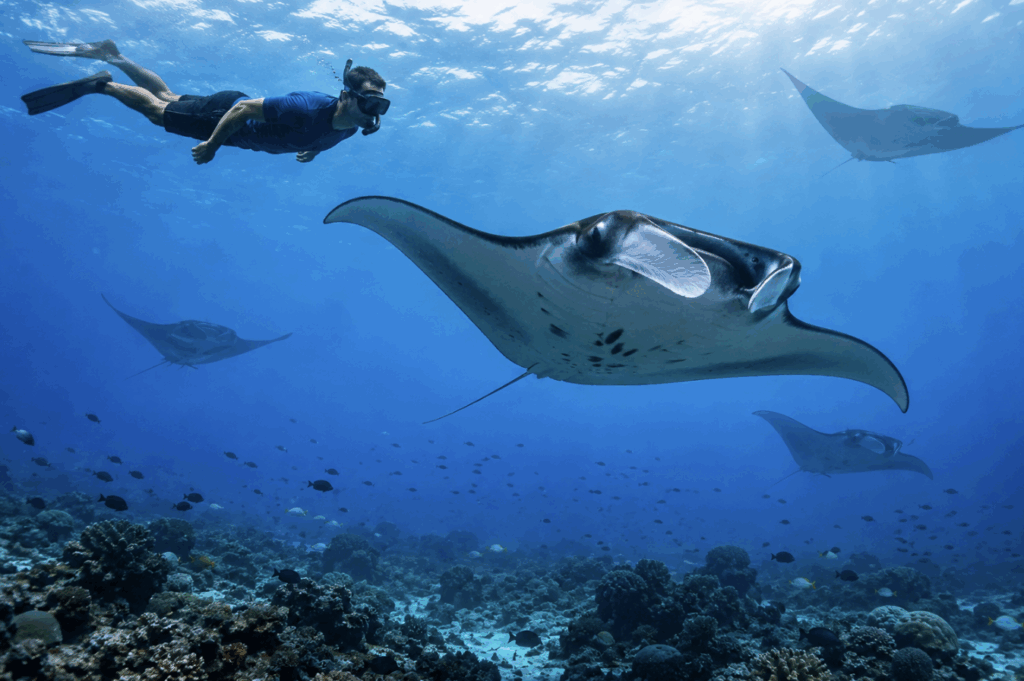
The Maldives is one of the world’s best-known destinations for manta ray encounters, with seasonal movements bringing these animals to different areas throughout the year. For travelers hoping to see them, understanding where mantas gather, how cleaning stations work, and how to behave around them can make the experience more rewarding.
A longer trip can also improve your chances. Manta rays are wild animals, and no dive site can guarantee a sighting. Spending several days in suitable areas gives you more opportunities to encounter them under different conditions.
The Maldives consists of numerous coral atolls surrounded by warm Indian Ocean waters. These reefs provide feeding grounds, cleaning stations, and sheltered areas used by a wide range of marine species.
Manta rays are particularly interesting because they often return to productive areas where they can feed or visit cleaning stations.
The animals are not simply passing through randomly. Their movements are influenced by currents, plankton availability, seasonal weather patterns, and other environmental factors.
This is why experienced dive operators pay close attention to local conditions when planning manta encounters.
One of the most fascinating places to observe manta rays is a cleaning station.
Cleaning stations are areas of reef where smaller cleaner fish remove parasites, dead tissue, and other material from larger marine animals.
Manta rays may arrive at these locations and remain in the area while cleaner wrasse and other reef fish work around their bodies.
The interaction can last for several minutes or longer.
For divers, this provides an opportunity to observe manta rays without chasing them through open water.
A manta may circle above the reef, turn onto its side, or hover in one area while cleaner fish move across its body.
The behavior can be particularly impressive because the animals are so large compared with the small fish performing the cleaning service.
Manta rays can be encountered in different parts of the Maldives, but the best location depends heavily on the season.
Areas of the central and southern atolls can become important manta habitats during different periods of the year.
Some locations are known for seasonal aggregations, while others may provide more regular opportunities at cleaning stations.
This is one reason local knowledge matters.
A dive guide who knows the current conditions can often make better decisions about where and when to look than a visitor following an old travel guide.
Before booking, ask the operator which regions are most suitable for manta encounters during your travel dates.
Manta rays do not remain concentrated in exactly the same locations throughout the year.
Seasonal changes in monsoon winds and ocean currents influence plankton distribution. Since mantas feed on plankton, these changes can affect where they spend their time.
In broad terms, different atolls can become more productive for manta sightings during different monsoon periods.
This means the “best” month depends on where in the Maldives you are traveling.
Rather than choosing your dates based solely on a generic manta calendar, look at the specific atoll and dive route you plan to visit.
A liveaboard can be particularly useful for travelers who want to explore multiple areas because the boat can cover more ground than a single island resort.
One of the most practical ways to increase your chance of seeing manta rays is simply to spend more time diving.
A single dive is a snapshot.
Even at a famous manta site, the animals may not appear during your particular visit. Currents can change, plankton can move, weather can affect visibility, and manta rays can simply choose another area.
A five- or seven-day diving itinerary gives you more opportunities.
If your primary goal is manta photography or observation, consider planning several dives around known manta areas rather than relying on one excursion.
This is one of the advantages of a longer liveaboard itinerary.
You may be able to visit multiple cleaning stations and follow seasonal conditions instead of making one short trip to a single site.
Manta encounters do not always require scuba equipment.
Snorkelers can sometimes observe manta rays from the surface, particularly when the animals are feeding or moving through shallow areas.
Divers, however, can spend more time below the surface and observe behaviors such as cleaning-station visits from a different perspective.
Both experiences can be excellent.
The important thing is to avoid treating the animals like performers.
A manta ray may approach you, pass by at a distance, or disappear before you get a good photograph.
The experience should always be based on observation rather than pursuit.
Manta rays are generally peaceful filter feeders, but they are still wild animals.
Good etiquette is essential.
Do not swim directly toward a manta.
If it approaches, remain calm and allow it to determine the distance.
Do not attempt to touch, ride, hold, or grab a manta ray.
Contact can disturb the animal and may remove protective mucus from its skin.
Mantas often move in predictable lines around cleaning stations.
Position yourself to the side rather than directly in front of the animal.
Good buoyancy is especially important around coral reefs.
Avoid kicking the reef or accidentally striking coral with your fins.
Fast movements can cause an animal to change direction.
Slow, controlled movements allow you to remain an observer without becoming a disturbance.
Manta rays are popular subjects for underwater photographers.
Their enormous wingspan and graceful movements can create spectacular images, but photography should never take priority over the animal’s welfare.
Avoid chasing a manta to get a closer shot.
Do not position yourself so close that the animal has to change direction.
If several divers are present, give everyone space rather than crowding around a single animal.
Using a camera with an appropriate lens can help you capture a good image without approaching too closely.
Sometimes the best photograph is taken when the manta is simply passing naturally through the frame.
Cleaning stations are particularly sensitive because manta rays may return to these locations repeatedly.
If divers crowd the area or repeatedly approach animals, the mantas may leave the station.
That can affect both the quality of the encounter and the animals’ normal behavior.
Divers should therefore follow the instructions of local guides.
Your guide may ask you to remain at a certain depth, stay behind a boundary, or position yourself away from the main cleaning area.
These rules are not designed to limit the experience. They help protect the behavior that makes the site valuable in the first place.
A typical manta dive begins with a briefing.
The guide explains the dive site, expected conditions, current direction, entry point, and manta etiquette.
Once underwater, the group may move toward a known cleaning station or feeding area.
The guide will often look for signs of manta activity before deciding where the group should wait.
If a manta appears, the best approach is usually to remain still.
You may see one animal make several passes or encounter multiple mantas moving through the area.
The experience can last only a few minutes or continue for much longer.
There is no predictable schedule because the animals are wild.
Manta rays are important members of marine ecosystems.
Their presence also supports tourism economies because divers and snorkelers travel specifically to observe them.
This creates an economic incentive for protecting manta habitats.
Responsible tourism can contribute to conservation by encouraging protection of reefs, cleaning stations, and feeding areas.
Visitors can support this by choosing operators that follow responsible wildlife guidelines and by avoiding activities that disturb marine life.
Some organizations also conduct manta research and identification programs, allowing individual animals to be tracked through photographs and other observations.
Both accommodation styles can work.
A resort can be ideal if you want comfortable land-based accommodation, beaches, restaurants, and a relaxed schedule.
A liveaboard may be better if manta rays are the main reason for your trip.
Because a liveaboard moves between different dive locations, it can offer greater flexibility when conditions change.
It may also allow you to spend more days diving and reach areas that are less practical from a single resort.
If your main goal is diving with manta rays in the Maldives, compare the route rather than choosing a boat simply because it advertises manta encounters.
Ask where the itinerary travels, what months it operates, how many dives are scheduled, and which areas are included.
You do not need an enormous amount of equipment for a manta-focused trip.
Consider bringing:
If you are traveling on a liveaboard, check whether towels, rental equipment, and other essentials are included.
The best period depends on the region because manta movements are influenced by seasonal monsoons, currents, and plankton availability. Ask local operators about the specific atoll you plan to visit.
Manta rays can be encountered in several Maldivian atolls. Their location changes seasonally, so the most productive area depends on your travel dates.
Manta rays are generally peaceful filter feeders and are not considered a threat to divers. However, they are large wild animals and should always be observed respectfully.
Yes. Mantas can sometimes be seen by snorkelers, particularly in areas where they feed or gather near the surface.
No. Divers should never touch, grab, ride, or chase manta rays.
Cleaning stations are areas where smaller cleaner fish remove parasites and other material from larger marine animals. Mantas may repeatedly visit these locations.
Generally, spending more time in suitable manta habitats gives you more opportunities. However, sightings can never be guaranteed because mantas move naturally according to environmental conditions.
A liveaboard can be an excellent option because it can visit multiple dive areas and provide several days of diving. This may be useful when manta sightings vary by location and season.
Swimming alongside a manta ray can be one of the most memorable experiences in the Maldives, but the best encounters happen when travelers allow the animals to behave naturally.
Understanding cleaning stations, researching seasonal movements, and following responsible diving etiquette can make a significant difference.
If seeing mantas is your main goal, avoid relying on a single dive. A longer trip gives you more opportunities to visit productive areas and adapt to local conditions.
Whether you choose a resort or a liveaboard, focus on the quality of the itinerary, the knowledge of the dive guides, and the operator’s approach to marine-life protection.
The Maldives offers an extraordinary opportunity to observe manta rays in their natural environment. The most rewarding encounter is not the one where you get closest, but the one where you can watch these remarkable animals move freely without being disturbed.
Counter
101 Countries • 1432 Cities