

Space is one of the biggest challenges in a commercial kitchen. A grill or flat-top may provide plenty of cooking surface, but the area around it can become crowded quickly once a busy service begins.
Ingredient pans, utensils, squeeze bottles, seasonings, cookware, and other supplies all need to be accessible. When there is nowhere specific to put them, they begin competing for the same countertop and grill space. That can make the station harder to navigate and force cooks to spend more time reaching, turning, and moving equipment around.
The answer isn’t always to buy a larger grill or add another table.
Often, the better solution is to make more effective use of the space that already exists around the grill.
With the right commercial grill accessories, operators can create additional storage and working areas while keeping frequently used items close to the cook. Here’s how to maximize space on a commercial grill station and build a more efficient cookline.
Before adding accessories, look at how the grill station operates during a busy shift.
A station can appear perfectly organized before service and become completely different once orders start coming in. Ingredients get moved closer to the grill, utensils accumulate around the cooking surface, and pans begin taking over available workspace.
Pay attention to where these problems occur.
Ask:
The answers can help identify which areas need additional organization.
The goal isn’t to add accessories simply because there is room for them. The goal is to use accessories to solve specific workflow problems.
One of the easiest ways to maximize a commercial grill station is to stop treating the cooking surface as general-purpose storage.
A flat-top grill is valuable working space. Using portions of it to hold pans, bottles, utensils, or other supplies reduces the amount of surface available for cooking.
Moving supporting items into designated areas can immediately make the station feel less crowded.
This is where additional shelves and pan holders can become useful. Instead of allowing everything to accumulate wherever space is available, the station can have separate areas for cooking, ingredients, tools, and supplies.
The result is a more deliberate workflow:
Cooking space stays available → supporting items have dedicated locations → the station becomes easier to manage.
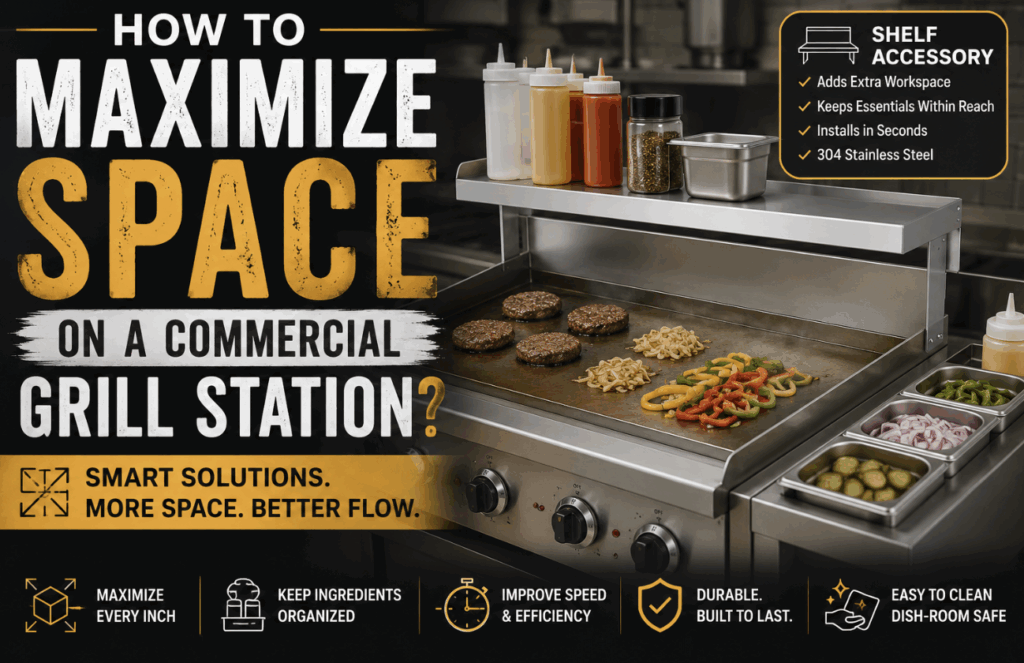
A purpose-built grill shelf rack can be a practical way to create additional workspace without adding another freestanding table to the cookline.
The Grill Advantage Shelf Accessory is designed specifically for commercial flat-top grills and creates additional vertical space by lifting accessories and pan holders away from the griddle surface. According to the manufacturer, it is designed to fit a wide range of flat-top griddle sizes and can be installed and removed without power tools.
This distinction is important.
The purpose isn’t simply to add another shelf. It is to move useful workspace into an area that would otherwise be difficult to utilize efficiently.
For a busy grill station, that can provide a dedicated location for tools and other essentials while preserving the primary cooking surface for food.
When a commercial kitchen runs out of counter space, the natural reaction is often to look for another table.
But additional tables consume floor space, which can create another problem in an already crowded kitchen.
Vertical organization offers a different approach.
A grill shelf system can create useful space above the griddle, allowing certain accessories and supplies to be positioned without taking over the countertop or cooking surface.
The Grill Advantage system uses a backsplash as part of its mounting setup. Its Shelf Accessory is designed to mount to the Backsplash Extender, creating a vertical foundation for the shelf.
This allows the grill station to make better use of its existing footprint.
For restaurants, food trucks, and other compact cooking environments, that can be particularly valuable.
Not everything in a kitchen needs to be positioned directly beside the cook.
Instead, think about frequency of use.
The ingredients, tools, and supplies that are used repeatedly during every service should generally be the easiest to access. Less frequently used items can remain in secondary storage.
This simple approach can make a significant difference to station organization.
For example, a cook may repeatedly need specific tools or ingredients throughout a rush. If those items are positioned several steps away, the cook has to repeatedly turn or leave the station.
Keeping frequently used supplies closer can reduce that unnecessary movement.
The purpose of additional grill workspace isn’t to store everything beside the griddle. It’s to put the right things in the right places.
Food pans are another major source of clutter around commercial grills.
When multiple pans are placed across a countertop, they consume valuable workspace and can make it difficult to reach other ingredients.
Dedicated pan holders provide another option.
A grill station can be organized so that frequently used ingredients occupy designated pan positions, while backup ingredients remain in refrigeration or other storage areas.
This approach has two advantages.
First, it frees up countertop space.
Second, it creates consistency. When cooks know where particular ingredients are located, they don’t have to search for them during a rush.
The Grill Advantage system includes accessories such as pan holders that integrate with its broader grill organization setup.
The area beside a commercial grill can also become valuable working space.
A grill sidebar can provide another location for compatible food pans and accessories without requiring another freestanding workstation.
This is particularly useful when the main countertop is already being used for preparation or plating.
By combining a shelf, sidebar, and pan holders according to the needs of the station, operators can create several distinct working zones around a single grill.
For example:
Above the grill: shelf and supporting accessories
Beside the grill: ingredient pans and frequently used supplies
Primary surface: cooking
Prep area: preparation and finishing
The exact arrangement depends on the kitchen, but the principle is the same: give each part of the station a defined job.
The backsplash doesn’t have to be treated solely as a boundary between the grill and the surrounding kitchen.
With compatible accessories, it can become part of the station’s organizational structure.
A Backsplash Extender can provide the vertical foundation for accessories such as the Shelf Accessory. The manufacturer states that the Shelf Accessory is intended for grills with at least a 3-inch backsplash and is designed to work with a wide range of flat-top grill brands.
This approach allows restaurants to expand the functionality of the station without continually adding horizontal surfaces.
Before purchasing any accessory, however, operators should verify the grill’s dimensions, backsplash configuration, and compatibility requirements.
The most effective commercial grill station isn’t necessarily the one with the most accessories.
It is the one where every accessory serves a clear purpose.
If your main problem is a lack of working surface, a shelf may be the logical starting point.
If ingredient pans are constantly taking over your prep area, pan holders may provide a better solution.
If the space beside the grill is unused, a sidebar can help turn it into a functional zone.
If you need additional vertical capacity, a backsplash extender may provide the foundation for a larger setup.
This problem-first approach prevents the station from becoming overloaded with equipment.
Accessories used around a commercial grill need to withstand demanding conditions.
Heat, grease, moisture, food residue, frequent cleaning, and repeated use are all normal parts of a professional cooking environment.
The Grill Advantage Shelf Accessory is made from 304-grade heavy-duty stainless steel and is described by the manufacturer as fully dish-room safe. The recommended cleaning process includes scrubbing, cleaning, sanitizing, drying, and reinstalling the component.
For any commercial grill accessory, operators should consider not only how much workspace it creates but also how easily it can be cleaned and maintained.
Good organization should make the kitchen easier to operate—not harder to clean.
The best way to determine whether a grill station is efficiently organized is to watch it during a busy shift.
Look for recurring problems.
Are cooks constantly moving pans?
Are tools being placed on the cooking surface?
Are employees walking away from the grill to retrieve commonly used ingredients?
Does the prep area become crowded before the cooking surface does?
These observations can tell you more than a static layout diagram.
Once the problem is identified, adjust the position of shelves, pan holders, and other accessories around the actual workflow.
The ability to remove and reposition certain components can make this process easier. Grill Advantage specifically describes its shelf system as easy to install and remove, allowing the setup to be adapted to the needs of the station.
Maximizing commercial grill space isn’t about squeezing more equipment into a limited area.
It’s about using the available space intelligently.
A shelf can create an additional working surface. A sidebar can turn unused space beside the grill into a useful ingredient zone. Pan holders can give frequently used ingredients dedicated positions, while a backsplash extender can provide the vertical foundation for additional accessories.
Together, these components can help transform a crowded grill into a more organized workstation.
The most important consideration is always the workflow of the people using the station. Think about what cooks reach for most often, where clutter develops, and which movements could be eliminated.
Then build the station around those observations.
A commercial grill station doesn’t necessarily need a larger footprint to become more productive.
In many cases, the opportunity is already there—in the unused space around the grill.
By keeping the cooking surface clear, using vertical space, organizing food pans, and adding dedicated workspace where it is needed, restaurants can create a cookline that is easier to navigate during even the busiest service.
A grill shelf rack can be one part of that solution, particularly when the goal is to add useful workspace without taking over the floor or primary cooking surface.
Ultimately, the best commercial grill station is one where everything has a place, frequently used items stay within reach, and the space around the grill supports the cook instead of getting in the way.
That is how you turn limited grill space into a more efficient workstation.
Counter
101 Countries • 1432 Cities